
You Break (the build), You Bought It
The Pulse 2.0 feature train keeps on rolling. Latest stop: using Pulse to communicate responsibility for a build.
Breaking the build is something to avoid, but even more important is the reaction when it inevitably does break. The key is fixing it fast, before it starts breaking the team’s flow. The worst possible scenarios are:
- Everyone assumes somebody else is responsible, so nobody fixes it. The build stays broken.
- Multiple people assume responsibility without talking to each other. Effort is wasted as they all work on fixing the same problem.
Both of these scenarios can be fixed by the same solution: communication. Responsibility for fixing the build needs to be taken by one person, quickly, and communicated to the rest of the team. If nobody has taken responsibility, everyone needs to be aware.
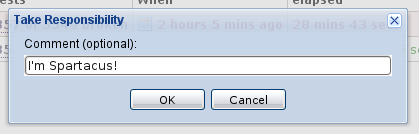
Pulse now supports this directly via the take responsibility feature. When you see the build is broken, you can click a link to take responsibility, optionally adding a comment:
Everybody can see who is responsible, both on the project home page, and the summary pages for all builds for the project:
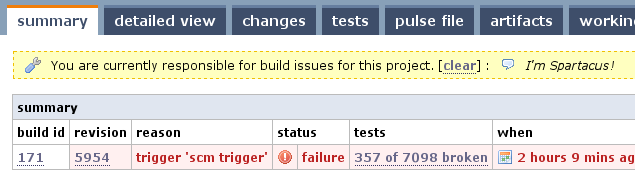
Only one person can be responsible at a time, so there’s no confusion. It’s up to the person responsible to decide when their job is done — although you can optionally have responsibility automatically cleared when a build completes successfully (a pretty good indicator that it’s fixed!).
So, start communicating today, and stop wasting time! You can download Pulse and try a free evaluation today. Happy building!


This entry was posted on Tuesday, June 2nd, 2009 at 8:53 am and is filed under Agile, Build, Continuous Integration, Technology, Testing, Zutubi. You can follow any responses to this entry through the RSS 2.0 feed. You can leave a response, or trackback from your own site.
June 2nd, 2009 at 9:44 am
Rohan says:Thanks for this feature, I started using it right away (via XML-RPC).
A system we were previously using had a similar feature but it associated responsibility with a particular revision rather than a person. This allowed anyone to blame a person other than themselves.
I haven’t quite made up my mind yet if only being able to take responsibility for yourself is better. I think that might lead to a more positive culture – there is no “blame”, just “taking responsibility”. On the other hand, the “taking responsibility” model is almost useless when dealing with “old school” developers who are unlikely to ever admit to making a mistake.
June 2nd, 2009 at 10:20 am
Hey Rohan,
Glad you like this feature! Being able to “blame” other people is an interesting capability — if indeed you do have cultural issues with people taking the blame themselves. I’d be interested in hearing how the current functionality works out for you, to see if the “taking” rather than “blaming” model can catch on in more reluctant quarters ;).